
Below are the materials shared at Moving Forward: Common Core State Standards Implementation and Assessment.
Leading the Common Core PowerPoint
Leading the Common Core Notetaker
Towards Effective Teacher PDF
Below are the materials shared at Moving Forward: Common Core State Standards Implementation and Assessment.
Leading the Common Core PowerPoint
Leading the Common Core Notetaker
Towards Effective Teacher PDF
Elementary and secondary school educators in Billings, Montana worked through elements of the ‘Core Task Project’ and ‘Advancing Literacy Practice with the Common Core.’ You can find all of the resources shared over the two days below. Note: some of the materials and video content are linked in the PowerPoint.
June 24th Elementary PowerPoint
June 25th Secondary PowerPoint
In a piece for ASCD, principal Matt Renwick describes how he moved his staff through “collaborative inquiry” around close reading. Collectively, educators used a complex text on teacher evaluations to learn to analyze, annotate, and reflect.
Kim Yaris and Jan Burkins share favorite non-fiction books that support Common Core.
A visual guide to every single learning theory. (Well, at least a lot of them.)


During the question and answer portion of a speech given before the Strategic Data Project, College Board President David Coleman is asked, “Where is the Common Core right now amidst the controversy from the Tea Party?” The answer stretches from minute 39:48 through minute 44:16 and involves an anecdote about close reading. In shot, if people understand that the Common Core allows for “work worth doing” and enables students to go deep with great literature and founding documents, detractors will understand why the CCSS has been a successful bipartisan effort. You can view the answer and the entire clip here.
Washoe educators moved through a second offering of the inservice course, Advancing Literacy Practice with the Core. The 15-hour class touches on a number of important features of the CCSS that enable practitioners to match classroom practice to the standards, 2014-2015 assessment, and well-vetted resources. You can review the course materials here.
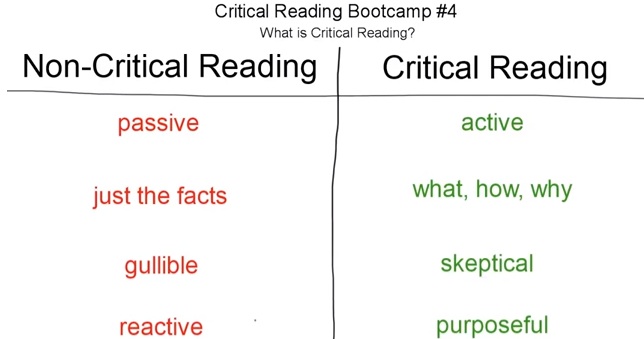
In several video posts from Robert Schombs, viewers are introduced to critical reading and strategies to effectively use this close reading method. In the post here, Schombs juxtaposes critical reading and non-critical reading as illustrated in the graphic below. In a second post (here), Schmobs explains how students often engage text by skimming and how close reading enables students to more accurately interact in text. As he notes, “Every word counts and sometimes a SINGLE word makes all the difference.”
The staff at Sarah Winnemucca Elementary created a Matrix of Vertical Agreements about Text Annotation. The guide serves to help answer the question why annotating is important and it further helps with identifying reasonable outcomes at each grade level. You can review the Matrix here.
NPR has posted a story describing what students are reading in out of school. Mellissa Block shares research from Renaissance Learning demonstrating that the complexity or difficulty of what students choose to read or are being assigned to read flattens in middle school. Eric Sticney, the educational research director for Renaissance Learning notes, “The complexity of texts students are being assigned to read has gradually declined by about three grade levels.”
The audio version of the story can be found here and the transcript here.
If you haven’t signed up for the Anthology Alignment Project, and you work in grades 6th through 10th, it is worth a look. As the project leaders note, the AAP is a free “library of revised lessons for common Anthologies (6th-10th grades), each carefully aligned to the CCSS. Each new lesson includes quality text-dependent questions, improved tasks, and a focus on academic vocabulary.”
The AAP includes the following: HMH Reading/Medallion, Holt Elements of Literature Holt Literature, Holt Literature & Language Arts, MH Glencoe: The Reader’s Choice, ML Language of Literature, ML Literature, PH Literature, PH Timeless Voices, and Timeless Themes.
You can access the AAP by visiting www.edmodo.com and joining group pkx4sp. If you are new to Edmodo, you can use the pictorial guide available here.
 Core Task Project

