Achieve The Core Newsletter

Student Achievement Partners has started a newsletter to keep educators informed about CCSS implementation. You can view the most recent newsletter here which includes articles about the Common Core, updates on the Basal Alignment Project, and an interview with CCSSM author Jason Zimba.
Posted in Common Core State Standards, Student Achievement Partners | Tagged , , , , , | Leave a comment

CCSS en Español

The Common Core State Standards have been translated into Spanish. The effort to translate the CCSS was led by the Sand Diego County Office of Education with support from the Council of the Chief State School Officers. As reported by EdWeek (here), “language scholars have also written ‘linguistic augmentations’ to address differences between English/language arts and Spanish/language arts.” You can find the translations here.

Posted in Common Core State Standards | Tagged , , , , , | Leave a comment

In 77 Seconds, ‘What are Good Books for Young Readers?’

What are good books for young readers? Dr. Elfrieda H. Hiebert answers this question in a 77 second Youtube clip here. Further, aside from answering the question, she directs viewers to free downloadable and printable resources here.

Posted in Common Core State Standards | Tagged , , , , , | Leave a comment

PreK-2 Draft of “No, David!” Exemplar

Personnel in the Office of Academics have been working on a PreK-2 close reading exemplar for David Shannon’s picture book “No, David!” Linked here is a draft of the exemplar and we need your help in getting it to a finished form.

If you work with PreK-2 children, would you be willing to pilot and vet the exemplar? In turn, we would hope you would fill out this Google Form so we can aggregate your field experience and then post a final copy.

Posted in Close Reading, Common Core State Standards, Core Task Project | Tagged , , , , , , , , , | 2 Comments

Reading Volume and the Common Core

The Core Shift Blast addresses two important issues including a “Volume of Reading” and the “8 Elements of the Literacy Block.” Readers will get a preview of research University of Nevada, Reno professor Dr. Diane Barone is doing as well some ideas on how to naturally integrate independent reading in the K-6 classroom. You can read the blast here and review previous blasts here.

Posted in Core Shifts Blast | Tagged , , , , , , | Leave a comment

Using the Core to Empower Teachers and Students

In a piece for the Huffingtonpost, 2010 Teacher of the Year Sarah Brown Wessling addresses several key concerns about the CCSS (here). She asks, “does the Common Core demoralize teachers?” and continues, “ The answer: No, but our misguided or unilateral decisions in the name of Core can.” She argues teachers need the space and freedom to go deep with the standards but systems need a “clear interpretation of the Standards.”


Posted in Common Core State Standards | Tagged , , | Leave a comment

Scoop.it! for CCSS Implementation

If you are trying to stay current on CCSS implementation, from an instructional coach perspective, the following Scoop.it! site will prove helpful. Curator Catherine Schmidt is updating the site daily with content to smooth the transition to CCSS and keep practitioners well informed.

Posted in Common Core State Standards | Tagged , , , , , | Leave a comment

5 Principles of CCSS

Teachingthecore has pulled out the 5 Principles of the Common Core from videos produced by the Hunt Institute. The principles are 1) College and Career Readiness 2) Based on best existing standards 3) Based on solid evidence 4) Clear focus and 5) Local flexibility/teacher judgment. You can read the descriptors of these principles as well as the entire post here.

Posted in Common Core State Standards | Tagged , , , , | 1 Comment

Text Complexity and the Common Core

MetaMetrics recorded a webinar on Valentines describing the importance of text complexity and the Common Core. Specific topics that may interest readers have been marked below.

Minute 6:45 The Crisis of Text Complexity

  • High school textbooks have declined in all subject areas over several decades
  • Average length of sentences in K-8 textbooks has declined from 20 to 14 words
  • Vocabulary demands have declined, eg., 8th grade textbooks = former 5th grade texts; 12 grade anthologies = former 7th grade texts
  • Complexity of college and careers texts has remained stead or increased

Minute 8:51 Recap of the ACT Study

  • Question type (main idea, word meanings, details) is NOT the chief differentiator between students scoring above and below the benchmark
  • Question level (higher order vs. lower order; literal vs. inferential) is Not the chief differentiator between students
  • What students could read, in terms of its complexity—rather than what they could do with what they read—is greatest predictor of success

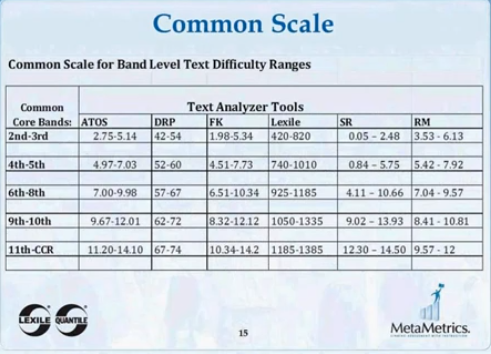
Minute 14:20: Common Scale of Text Complexity

  • Text MeasuresThe six measures now share a common scale—anchored by
    texts representative of those required in typical first-year-credit-bearing college courses and in workforce training programs
  • The common scale is being used by the testing consortia to decide what passages to put on their assessments
  • Image

Minute 18:50: Text Complexity Model

Continue reading

Posted in Complex Text, text complexity | Tagged , , , , , , | Leave a comment

Culturally Responsive Teaching and the CCSS

Teaching Tolerance Fellow Emily Chiariello describes her work around teaching the Common Core State Standards “with culturally responsive instruction” (full link here). She sees the CCSS and culturally responsive pedagogy as a strong fit citing teacher’s shared responsibility for teaching literacy. She notes that the CCSS enable us to move away from disabling text, texts that focus on skill and strategy development, to enabling text—texts that honor the diversity of the students we teach.

Posted in Common Core State Standards, Culturally Responsive Teaching | Tagged , , , , | Leave a comment