SBAC Fact Sheet

If you are trying to get a general sense of how many of our students will be assessing in 2014-2015, the Smarter Balanced Assessment Consortium has a released a fact sheet detailing key parts of their next generation assessment.  Readers are provided with a timeline, an overview of who is participating, implications for subpopulations, and several key links. Download here.

Posted in SBAC | Tagged , , , , , , | Leave a comment

CCSS Questions and Answers

Sandra Alberti, the Director of State and District Partnerships and Professional Development for Student Achievement Partners, shares several important answers, to questions many of us have been asking. The answers come from a presentation done in Illinois last week.

How will the Common Core impact early childhood education? Answer

What is the role of music and art in the Common Core? Answer

How will the Common Core State Standards be evaluated? Answer

Posted in Common Core State Standards, Student Achievement Partners | Tagged , , , , , | Leave a comment

Recent Trainings

We have conducted a number of training over the last three workdays and those materials are listed below. These included activities around the Core Task Project and work with Shift 1—Building a Coherent Body of Knowledge.

Core Task Project PowerPoint from Inservice Course

Core Task Project PowerPoint from Bailey Charter School

Shift 1 PowerPoint—Building a Coherent Body of Knowledge

Posted in Common Core State Standards, Content Knowledge, Core Task Project | Tagged , , , , | Leave a comment

Social Studies Units Link

The 4th through 6th grade social studies units will all be completed by June 3rd and will be available at this link.  The units all include close reads and integrate social studies and Common Core State Standards. You can view an example here.

Posted in Close Reading, Content Knowledge, Informational Text | Tagged , , , , | Leave a comment

Staying Current

There are a number of articles, recently posted at “Thinking Common Core” that may interest readers of this blog. There are pieces describing multiple perspectives on close reading; the value of emphasizing academic vocabulary; an inside view on the new assessments; and an editorial by the USDOE. You can access Thinking Common Core here.

Posted in Common Core State Standards | Tagged , , | Leave a comment

Help Build SBAC’s Digital Library

The Smarter Balanced Assessment Consortium is looking for educators to join their team and help build a digital library. They hope to recruit 92 educators with expertise in any of the following:

Formative assessment (e.g., collecting evidence of student learning as you teach and using it to adjust instruction)

The CCSS for ELA and Mathematics

General education

Gifted and talented students

English Language Learners (ELL)

Students with Disabilities (SWD)

You can learn more here.

Posted in Common Core State Standards, SBAC | Tagged , | Leave a comment

CL’s Meet to Learn about SS Units and Evidence Guides

Curriculum Leaders gathered to learn more about the Evidence Guides and social studies units for grades 4th through 6th. The units focus on important grade level outcomes from mining to Colonial America to Ancient Egypt. CLs reviewed one unit, Colonial America, and learned the rest of the units will be posted by the end of the school year for implementation this fall. The units emphasize important instructional shifts (e.g. text-dependent questions and academic vocabulary) as well as incorporating the close reading strategy.

Following the introduction to the SS units, CLs reviewed the Evidence Guides. The guides work backwards from the instructional shifts and enable teachers to monitor their daily and yearly planning. As noted several times in the documents, the guides are not for evaluative purposes but instead are “designed as a developmental tool for teachers and those who support teachers.”

Unit Overview

SS Unit PowerPoint Presentation

Colonial Life Unit

CL Introduction to Evidence Guides PowerPoint

Evidence Guides are posted here

Posted in Common Core State Standards, Content Knowledge, Student Achievement Partners | Tagged , , , , , , , , , | Leave a comment

Assessment and Instruction in the Era of CCSS

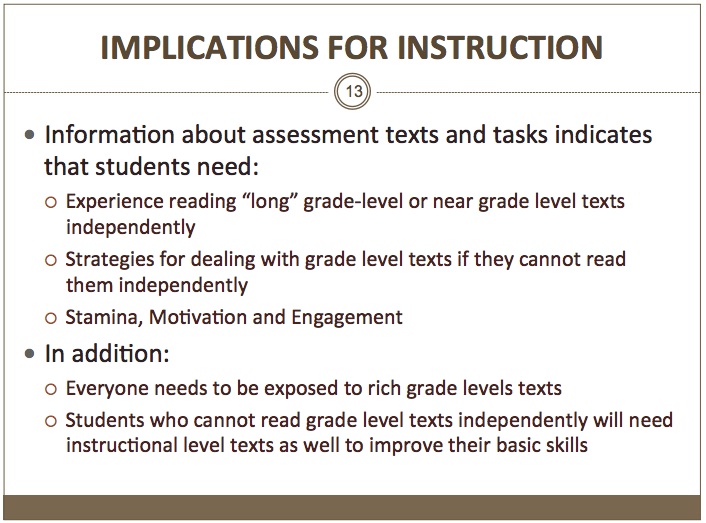
University of North Carolina Greensboro professor Dr. Karen Wixson shares a webinar on the CCSS and the instructional shifts. There are several key pieces of information that are worth reviewing including:

a)     the “claims” are driving the assessment and not the individual standards (minute 3:45).

b)      the implications for instruction (image below) at minute 11:45 and

c)      what a “performance task” will look like on the coming assessments (minute 18:15).

Wixson Implications

You can access the entire webinar here and the PowerPoint here.

Posted in Common Core State Standards, Instructional Shifts, SBAC | Tagged , , , , , | Leave a comment

Educators Work through CTP Materials

At Teach Fest, Learnzillion educators worked through elements of the Core Task Project. They talked about the close reading strategy, identified features of complex text and studied the guide to writing text-dependent questions. The Powerpoint can be found here and resources from the session can be found below.

The “instructional shifts” and “6=3” documents

Lazarus Close Reading Exemplar (from SAP)

Continue reading

Posted in Close Reading, Common Core State Standards, Core Task Project, Instructional Shifts | Tagged , , , , , , , | Leave a comment

PSA on the Common Core State Standards

The Council of Great City Schools has created several Public Service Announcements around the Common Core. Described as an explanation of the CCSS, the videos are an approachable way to give parents and community member’s context for why the CCSS were crafted and the implications for our students. You can find all of the videos here in both English and Spanish.

The videos were recently highlighted in Smarter News, an SBAC newsletter to help stakeholders transition to the coming 204-2015 assessments. The current issue also includes updates on the practice test, current work in the field, and answers to “frequently asked questions.”

Posted in Common Core State Standards | Tagged , , , , , , | Leave a comment