Wagner’s 21st Century Learning Skills and the CCSS

Teach Indy has helpfully posted a professional development video that overviews the Common Core State Standards, the instructional shifts, and several PARCC performance tasks here. In addition to the aforementioned, the presenters in the video make explicit connections between Tony Wagner’s research on 21st Century Learning and the front matter in the Core standards documents (image below) at minute 11:10.
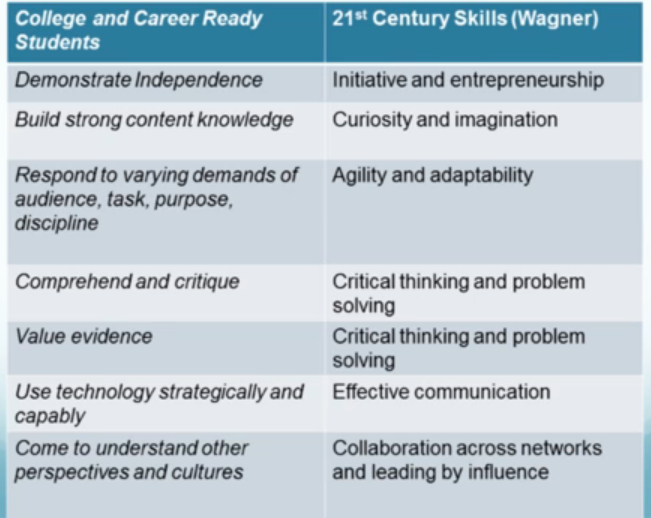
Screen Shot 2013-04-11 at 6.25.28 PM

Posted in Common Core State Standards, Instructional Shifts | Tagged , , , , , , , | Leave a comment

Next Generation Science Standards Are Now Available

The Next Generation Science Standards are finalized and available for download (here). The standards, part of an effort led by 26 states, are described as “rich in content and practice, with aligned curricula, pedagogy, assessment, and teacher preparation and development.” You can watch a video describing the case for the Next Generation Science Standards here.

In October, we shared a video link, with specific sections tagged, by Achieve Vice President for Content Research and Development, Stephen Pruit. You can access the post here.

Posted in Next Generation Science Standards | Tagged , , , | Leave a comment

Open Resources for Common Core

The National Math and Science Initiative (NSMI) have created resources, matched on the Common Core State Standards, which are available to teachers here. The materials include a number of free lessons for elementary and English teachers that promote the habit of using evidence in speaking and writing. The site is organized by strands including: leadership, curricular tools, instructional resources, and diverse student populations. 

Posted in Common Core State Standards | Tagged , , , , | Leave a comment

Accessing Sample Assessment Items

Green Bay Area Public School District Assessment Coordinator, Stephen Miller, has posted a Youtube video describing how educators can access sample SBAC assessment items. If you are having any difficulty navigating the Smarter Balanced website, Miller’s brief three minute and thirty second video is an excellent starting place.

Posted in CCSS, Common Core State Standards, SBAC | Tagged , , , , , | Leave a comment

Flipped PD

Sheleen DeLockery, working in School District 62 in Illinois, has put together the following flipped professional development around the ELA “instructional shifts” (here). Sheleen moves viewers through the shifts using video content and print resources and she has all of the work posted to her district’s website.

The video may prove especially helpful for those not familiar with the shifts required of the CCSS.


Posted in Common Core State Standards, Instructional Shifts | Tagged , , , , | Leave a comment

The Rise of Open Educational Resources

The Hechinger Report posted the following piece (here) on Open Educational Resources. They highlight national efforts including a number of items matched to the Common Core State Standards. Of note is this:

In Wiley’s home state, 30 teachers and 6000 students have participated in a pilot, the Utah Open Textbook Project. The teachers adopted open textbooks that were free to read online and $5 for a printed copy in middle and high school science classes. Initially there was no difference in standardized test scores for students using a $5 book vs a $100 book, while current research reflects a slight improvement in learning for students who used the open resources.

We have highlighted a number of important OERs since the inception of the blog including the Basal Alignment Project, www.achievethecore.org, and America Achieves. It is another reminder that we can find resources, matched to the CCSS and the instructional shifts, without having to pay for them.

Posted in Basal Alignment Project, Common Core State Standards, Student Achievement Partners | Tagged , , , | Leave a comment

Last Session of Leading the Core

The last session of the Leading the Core concluded with administrators looking at connections between the instructional shifts and the Danielson Framework. Administrators also got a preview of the next fall’s professional development plan and course offerings for leadership, site coaches, and classroom teachers. You can download the PowerPoint here and visit the Leading the Core Edmodo group here.

Posted in Common Core State Standards, Core Task Project | Tagged , , , , , , | Leave a comment

Publisher’s Criteria Webinar

The Council of Great City School and Student Achievement Partners hosted a webinar describing the Common Core State Standards Publisher’s Criteria (here). You can download the criteria for K-2 here and for 3-12 here.

The webinar highlights key features of the criteria that includes a description of what is in and what is out. For sites considering purchasing new material, the criteria are an important document to include in the process.

In and Out

Posted in CCSS, Common Core State Standards, Instructional Shifts, Student Achievement Partners | Tagged , , , , , , , | Leave a comment

“The Truth about Common Core”

There has been some confusion about the Common Core and Kathleen Porter-Magee and Sol Stern address several areas of misinformation and misinterpretation. They directly tackle important issues including the concern that the CCSS is a federal mandate (aka ‘ObamaCore’); that informational text will marginalize literature in the secondary classroom; and that CCSS is too “squishy” and “progressive.” You can read the entire article here.

Posted in Common Core State Standards | Tagged , , , , | Leave a comment

Complex Text: It’s Complicated

Laura Varlas shares a piece for Education Update on the importance of text complexity and strategies for accessing standard 10 (here). She underscores the importance of keeping instruction anchored in the text with these notes:

Instructional time: Complex texts take time, and the more time you spend outside the text, the less time you spend inside the text. Many materials and discussions spend as much time on student feelings about the text, or how the text relates to their experience, as they do with what’s going on inside the text.

Equity: When you go outside the text to students’ experiences, you privilege those students who happen to have those experiences or have practiced having these types of personal meaning making discussions in their home setting. That’s usually students from more affluent households. If you focus on just what’s in the text everyone has read and studied, you have more of a level playing field.

Rigor: It’s easier to go outside the text, and it’s a shortcut to student engagement. But it sends the message that the texts are not engaging on their own and that working hard to wrestle with texts is not a worthwhile endeavor.

Posted in Close Reading, Common Core State Standards, Complex Text, Student Achievement Partners, text complexity | Tagged , , , , , | 1 Comment