When Can you Trust the Experts?

My wife purchased “When Can you Trust the Experts: How to Tell Good Science from Bad in Education” by Dan Willingham as a holiday gift for me. The book provides a process for “sifting” through information and determining “which of the latest educational models, programs, and approaches are worthy of their attention.” Willigham, in the introduction, describes how “People are more likely to believe the contents of a book or magazine if its dimensions correspond to the Golden Ratio.” Consequently, “95 percent of the nonfiction books that seek to persuade are sold in dimensions within 2 percent of the Golden Ratio.” Admittedly, I haven’t finished the book but so far a great read.

You can download the first chapter of Willingham’s book here. You can watch Tom Bennett’s interview of Willingham here.

Posted in Professional Development | Tagged , | Leave a comment

Resources for the Common Core State Standards

The Wyoming Department of Education has shared “Resources for the Common Core State Standards.” The pdf is divided into three sections for parents, teachers, and leaders. You can visit the site and download the document here.

Posted in Common Core State Standards, Core Task Project | Tagged , , , , , , , | Leave a comment

Bridging CCSS Efforts Between UNR and WCSD

Faculty from the University of Nevada, Reno College of Education and personnel within Washoe County School District’s Office of Academics met to discuss work around the Common Core State Standards. The day started with an overview of the ELA/Literacy instructional shifts through video of David Coleman (minutes 13:00 through 26:30 here) and the math instructional shifts through video of Jason Zimba (minutes 10:56 through 13:57 here). Coleman is the current president of the College Board and Zimba is a mathematics and physics professor at Bennington College.

To view the PowerPoint and handouts, select from the files below.

Introduction to WCSD work around the Shifts PowerPoint

ELA instructional shifts

ELA 6=3 Shifts Crosswalk

Introduction to the math shifts link

Posted in Instructional Shifts, Professional Development | Tagged , , , , , , , | Leave a comment

Teaching American History Newsletter

The Northern Nevada Teaching American History Project has shared its most recent edition of Project Tahoe, a newsletter to support Social Studies teachers in their implementation of the Common Core. The newsletter includes teachers describing their use of close reading, the Basal Alignment Project, Socratic Seminars, and resources to support literacy in their content area. You can download the newsletter here.

You can subscribe to the newsletter by contacting Katie Anderson at KMAnderson@washoeschools.net.

Posted in Social Studies | Tagged , , , , , , , | Leave a comment

Close Reading: How is it Taught?

Dr. Louisa Moats, contributing author to the Common Core State Standards, answers the question here.

Posted in Close Reading | Tagged , , , , , | Leave a comment

Writing with the Common Core

www.sharemylesson.com, the website created by the American Federation of Teachers, has enlisted the aide of a number of distinguished academics to assist with the implementation of the Common Core.  Dr. Louisa Moats, a contributing writer of the Common Core State Standards, is one of these academics and she has shared a webinar to help teachers address the Common Core writing standards. Moats notes that writing is the most difficult of all language skills to develop and takes the longest time to develop.  She adds, it is the skill that the fewest number of students will gain proficiently with.

At minute 12:00, we learn that some of the models of teaching writing in K-12 came from studies of college students and then applied it to elementary schools–we should be skeptical about some of these writing processes or schemes. Moats gets very specific about planning at minute (13:25) noting that students need to write with source material; absent a common classroom experience, children will unnecessarily struggle. Translating—generation of text—(minute 15:20) and Review and Revision at minute 16:50 describe the last two parts of the writing process many of us are familiar with. Moats, however, cautions that revision requires a level of perspective taking, affective intelligence and pragmatic skills that many children may lack—especially struggling students.

At minute 43:00, Moats outlines how she would take students through the writing process. It starts with 1) picking a topic from a shared experience 2) setting a goal and making sure that students have generated a word bank and 3) assistance with organization so that students have an acute sense of what the final product will look like.

The webinar is well-worth watching and can be viewed here. The PowerPoint can be downloaded here.

Posted in Writing to Sources | Tagged , , , , , , , | 1 Comment

Accountable Talk to Support the Common Core

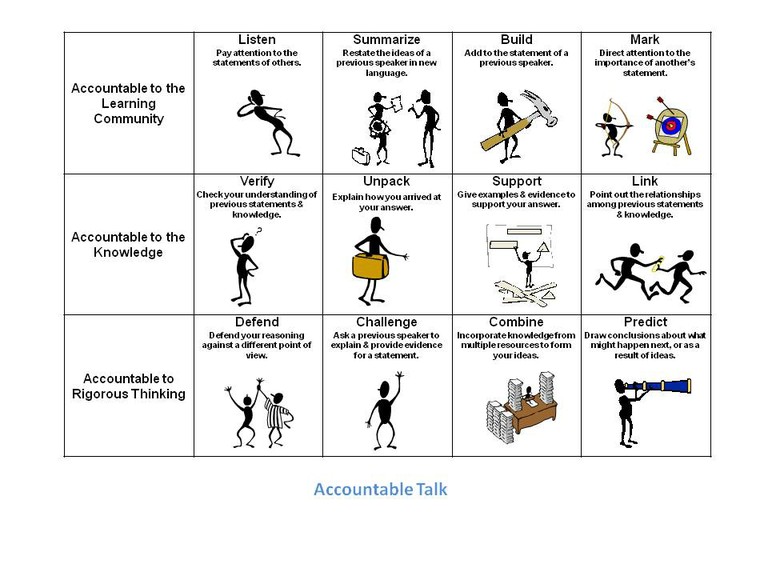
As part of the Core Task implementation Project (CTiP), classroom teachers worked with the Accountable Talk Sourcebook. The sourcebook is a rich resource and complements many of the indicators within the Instructional Practice Guides (And it’s free!).

For those interested in taking advantage of Accountable Talk in their classrooms, the Sourcebook as well as these stems and these Accountable Talk Cards may prove helpful.

AT Graphic

Posted in Core Task Project, CTiP | Tagged , , , , , | 1 Comment

How Writing can Improve Reading

In a guide shared by the Carnegie Corporation of New York and the Alliance for Excellent Education, Vanderbilt professors Steve Graham and Michael Hebert describe the evidence for how writing can improve reading. Among the recommendations:

Have Students Write About the Texts they Read: Students’ comprehension of science, social studies, and language arts texts is improved when they write about what they read

Teach Students the Writing Skills and Processes that go into Creating Texts: Students’ reading skills and comprehension are improved by learning the skills and processes that go into creating texts

Increase how much Students Write: Students’ reading comprehension is improved by having them increase how oftehn they produce their own texts.

You can download the guide here.

Posted in Writing to Sources | Tagged , , , , , , | Leave a comment

Increasing Students’ Engagement with Complex Texts

Screen Shot 2013-11-26 at 7.19.16 AMIf you have been looking for informational texts for elementary students, the following free resource might help. FYI for Kids is a collection of magazine articles to increases “students’ engagement and proficiency with complex text.” The digital collection features a menu for users to locate articles by grade and content area. The magazines can be found here.

Posted in Informational Text | Tagged , , , , , , , , , , , | Leave a comment

This Blog takes to Twitter

Although the blog links to Twitter,  Tweets were made only to update followers about posts on this site. This will change. Interested readers can follow coretaskproject to see content directly linked to Common Core and articles related to education. Follow here.

Posted in Core Task Project | Tagged , , , , , , | Leave a comment